The Enigmatic Flat-Headed Cat: A Rare Feline of Southeast Asia's Wetlands
In the shadowy realms of Southeast Asia's peat swamps and riverine forests, a small, elusive feline moves with silent grace. The flat-headed cat (Prionailurus planiceps), named for its distinctive flattened skull, is one of the world's least-known wild cats. With fewer than 2,500 mature individuals estimated in the wild, this species faces critical threats from habitat loss and human encroachment. This article delves into the biology, ecology, and conservation challenges of this remarkable carnivore, drawing on recent scientific research and field observations.
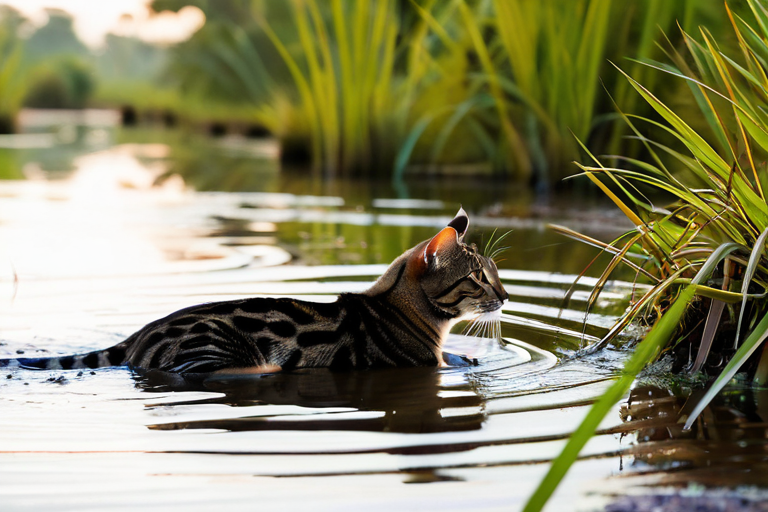
A flat-headed cat prowling through a dense wetland at dusk, showcasing its semi-aquatic adaptations. Image credit: Wildlife conservation sources.
Morphological and Behavioral Adaptations
The flat-headed cat's unique physical traits are a testament to its specialized niche. According to the IUCN Red List of Threatened Species, this small cat weighs between 1.5 to 2.5 kilograms, with a body length of 41–50 cm and a short tail of 13–15 cm. Its most striking feature is the flattened skull, which may aid in navigating dense vegetation or capturing prey in aquatic environments. The partially webbed feet, a rare trait among felids, facilitate movement in muddy substrates and shallow waters, making it a proficient swimmer and fisher.
Behavioral studies, such as those cited by the Cat Specialist Group, reveal that flat-headed cats are primarily nocturnal and solitary. They exhibit a diet heavily reliant on aquatic prey, including fish, frogs, and crustaceans, supplemented by small rodents and birds. Their hunting strategy often involves patiently waiting at water's edge or using their sensitive whiskers to detect movements underwater, a behavior akin to other semi-aquatic mammals.

A detailed view of a flat-headed cat's facial structure, highlighting its flattened head and large eyes. Image credit: Feline research archives.
Habitat and Distribution
Flat-headed cats are endemic to Southeast Asia, with their range spanning parts of Thailand, Malaysia, Indonesia (Sumatra and Borneo), and possibly Brunei. They inhabit lowland tropical rainforests, freshwater swamps, and mangrove forests, typically at elevations below 100 meters. Research from World Wildlife Fund (WWF) indicates that these habitats are increasingly fragmented due to agricultural expansion, particularly oil palm plantations, which poses a significant threat to their survival.
The species' reliance on wetland ecosystems makes it vulnerable to drainage and pollution. A study published in the Journal of Threatened Taxa notes that flat-headed cats have one of the smallest geographic ranges among wild cats, with an estimated extent of occurrence of less than 100,000 square kilometers. This limited distribution, combined with habitat degradation, underscores the urgency of conservation efforts.
Conservation Status and Threats
The flat-headed cat is classified as Endangered on the IUCN Red List, with populations declining. Primary threats include habitat loss from deforestation, conversion of wetlands for agriculture, and water pollution from industrial activities. Additionally, incidental capture in fishing nets and traps set for other animals contributes to mortality. According to Panthera, a global wild cat conservation organization, there is limited enforcement of protective laws in parts of its range, exacerbating these pressures.
Conservation initiatives focus on habitat protection and research. For example, the Species Conservation Foundation supports camera-trapping studies to monitor populations and better understand their ecology. Community-based programs aim to reduce human-wildlife conflict by promoting sustainable fishing practices and raising awareness about the species' ecological role.

A scene depicting conservationists monitoring flat-headed cat habitats in a protected wetland area. Image credit: Environmental NGO reports.
Research and Future Outlook
Scientific knowledge about flat-headed cats remains sparse, largely due to their elusive nature and inaccessible habitats. Recent advances in non-invasive techniques, such as environmental DNA (eDNA) analysis, offer promising avenues for population assessments without direct disturbance. Collaborative projects between institutions like the Smithsonian Institution and local universities are working to fill data gaps on their genetics and behavior.
The future of the flat-headed cat hinges on integrated conservation strategies. Protecting key wetland corridors, enforcing anti-poaching laws, and engaging local communities are critical steps. As highlighted by experts in felid conservation, this species serves as an indicator of wetland health, and its preservation could benefit broader biodiversity in Southeast Asia.
In summary, the flat-headed cat is a fascinating yet vulnerable component of Southeast Asia's ecosystems. With continued research and concerted conservation efforts, there is hope for stabilizing its populations. For more information, refer to authoritative sources such as the IUCN Red List and wildlife conservation organizations dedicated to felid protection.