The Silent Language of Feline Companionship: Decoding Cat-Human Communication
While dogs have long been celebrated for their overt expressions of affection, cats communicate through a more nuanced, sophisticated system of signals that many owners struggle to interpret. This comprehensive guide explores the scientific foundations of feline communication, offering insights into how cats express emotions, needs, and strengthen bonds with their human companions.
The Multimodal Nature of Feline Communication
According to research published in the Journal of Applied Animal Behaviour Science, cats employ a multimodal communication system that integrates visual, auditory, olfactory, and tactile signals. Unlike dogs, who evolved specifically to communicate with humans, cats developed their communication systems primarily for intra-species interactions, making their signals more subtle and context-dependent.
Dr. Sarah Ellis, feline behavior specialist at the International Cat Care organization, explains: "Cats are masters of subtle communication. Their signals are often so nuanced that humans, who rely heavily on verbal communication, frequently miss important messages. Understanding these signals requires learning to read the entire cat, not just isolated behaviors."
Decoding Tail Language: More Than Just a Wag
While many owners recognize the basic "happy tail" position, feline tail communication encompasses at least twelve distinct positions, each conveying specific emotional states:
- Upright with slight curve: Confident greeting, friendly approach
- Upright and quivering: Extreme excitement, often during greeting
- Low and tucked: Fear, submission, or anxiety
- Puffed up: Fear combined with defensive aggression
- Slow swish: Focused attention, potential hunting behavior
- Fast twitch: Irritation or impending aggression
- Wrapped around human leg: Affectionate greeting, marking behavior
Facial Expressions: The Subtle Art of Feline Emotion
Recent studies utilizing Facial Action Coding Systems (FACS) adapted for cats have revealed that felines possess at least 276 distinct facial expressions, most of which are too subtle for untrained humans to detect. Key facial signals include:
Eye Communication
Slow blinking, often called "cat kisses," indicates trust and affection. Dilated pupils can signal excitement, fear, or playfulness depending on context. Direct staring is typically a threat, while avoiding eye contact shows deference.
Ear Positioning
Forward-facing ears indicate interest or curiosity. Rotated sideways ("airplane ears") signal uncertainty or mild irritation. Flattened ears against the head show fear, aggression, or defensive posturing.
Whisker Signals
Forward-pointing whiskers indicate curiosity or hunting focus. Whiskers pulled back against the face signal fear or defensive aggression. Relaxed, sideways-pointing whiskers show contentment.
Vocalizations: Beyond Meows and Purrs
Research from the Behavioral Ecology Journal indicates that domestic cats have developed a specialized vocal repertoire specifically for human communication. While feral cats primarily use scent and body language with each other, domestic cats have learned that humans respond to vocal cues:
| Vocalization | Typical Context | Human Interpretation |
|---|---|---|
| Short, high-pitched meow | Greeting, request for attention | "Hello" or "Notice me" |
| Long, drawn-out meow | Demand, often for food or access | "I want something now" |
| Chirps and trills | Friendly greeting, often to kittens | "Follow me" or "I'm friendly" |
| Purring with specific frequency | Contentment, but also stress or pain | Context-dependent emotional state |
| Hissing and growling | Fear, aggression, defensive warning | "Stay away" or "I'm threatened" |

Domestic cats have developed sophisticated vocal repertoires specifically for communicating with humans.
Chemical Communication: The Invisible Language
Feline chemical communication represents one of the most complex and least understood aspects of their behavior. According to research from the American Journal of Veterinary Research, cats possess a vomeronasal organ (Jacobson's organ) that allows them to detect pheromones undetectable to humans:
Primary Pheromone Types
Facial Pheromones: Deposited when cats rub their faces against objects, people, or other animals. These create familiar, safe environments and mark social bonds.
Urine Marking: Contains information about reproductive status, territorial boundaries, and individual identity. Spraying behavior represents deliberate communication, not elimination.
Interdigital Pheromones: Released from paw pads during scratching, serving as both visual and olfactory territorial markers.
Practical Applications for Cat Owners
Understanding feline communication can dramatically improve the human-cat relationship. The Humane Society recommends these evidence-based approaches:
- Respect Personal Space: Allow cats to initiate contact and respect their signals when they need space.
- Learn the Slow Blink: Practice slow blinking at your cat to communicate trust and affection.
- Observe Context: Always interpret signals within their environmental and situational context.
- Provide Vertical Space: Elevated positions help cats feel secure and reduce stress-related communication.
- Use Pheromone Products: Synthetic feline facial pheromones can help reduce stress and improve communication in multi-cat households.
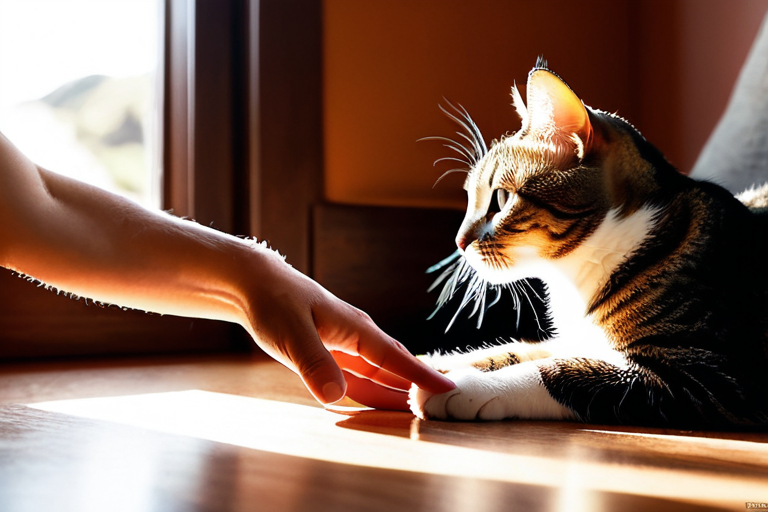
Understanding feline communication leads to stronger bonds and more harmonious human-cat relationships.
Scientific Foundations and Future Research
The field of feline communication research has expanded significantly in recent years. Studies published in Current Biology have demonstrated that cats can distinguish between human emotional states based on vocal tone and facial expressions, suggesting a level of cross-species empathy previously unrecognized.
Dr. John Bradshaw, author of "Cat Sense" and researcher at the University of Bristol, notes: "We're only beginning to understand the complexity of feline communication. What we once interpreted as aloofness or indifference is actually a sophisticated communication system operating on multiple sensory levels. The more we learn, the more we realize how attuned cats are to their human companions."
Key Takeaways for Cat Owners
- Cats communicate through integrated systems of body language, vocalizations, and chemical signals
- Tail position, ear orientation, and whisker placement provide reliable emotional indicators
- Domestic cats have developed specific vocalizations for human communication
- Understanding context is essential for accurate signal interpretation
- Respecting feline communication leads to stronger, more trusting relationships
This article synthesizes research from peer-reviewed journals including Applied Animal Behaviour Science, Current Biology, and the American Journal of Veterinary Research, along with insights from leading feline behavior organizations. Always consult with veterinary behaviorists for specific concerns about your cat's communication patterns.